Readers researching hunyuan 3d can use this independent Tripo AI and SupaVoxel comparison to see how watertightness and wall thickness affect a printable image-to-3D mesh. Hunyuan 3D was not tested in this article.
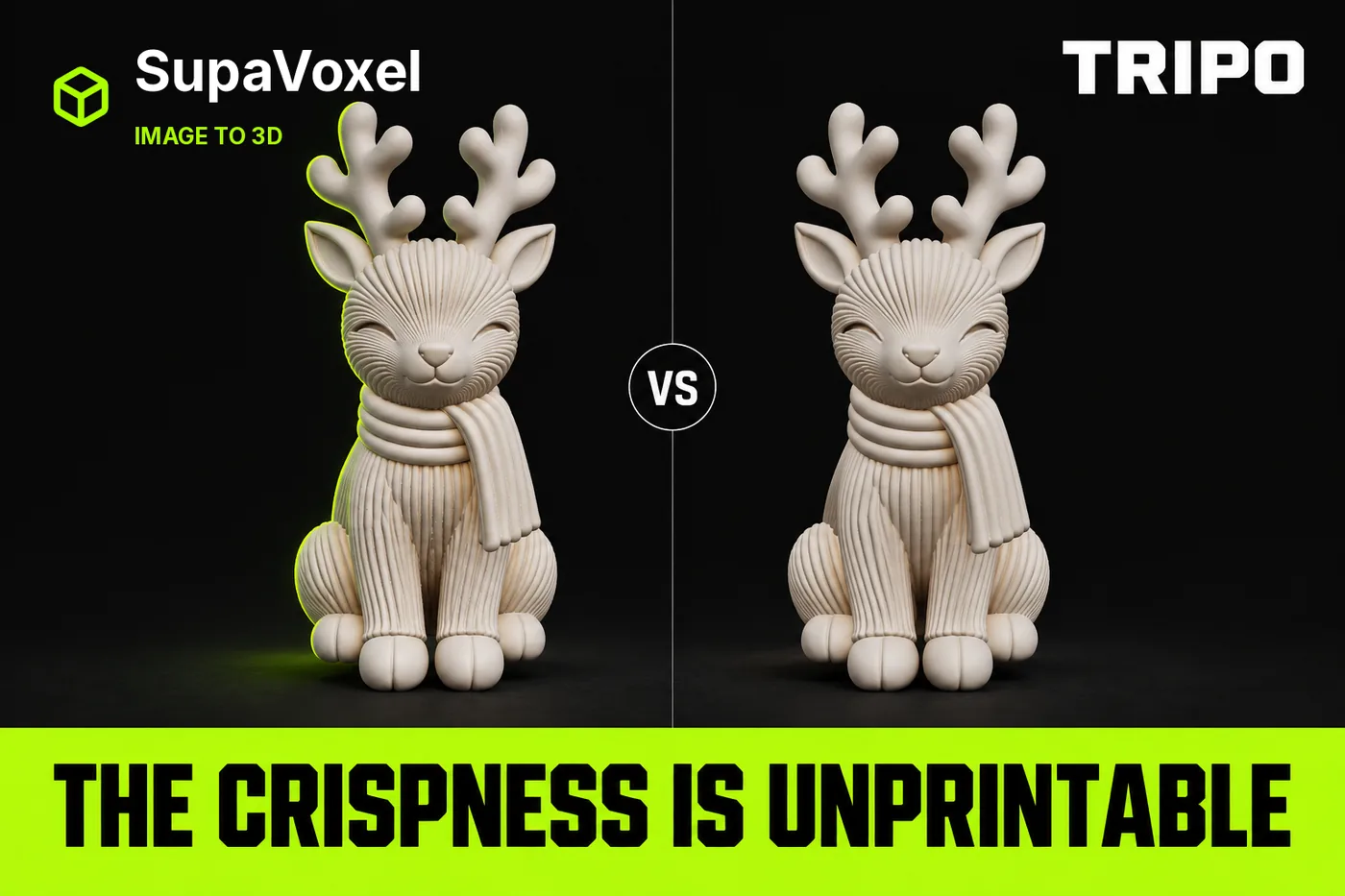
Disclosure: this is an independent hands-on test. Both tools were run on ordinary customer accounts; neither company supplied review access or saw this piece before publication.
My verdict in 60 seconds — Tripo 60/100, SupaVoxel 90/100
I handed one photograph — a seated chibi reindeer in a corduroy scarf, two branched antlers, two leaf ears — to two image-to-3D products on the same day, downloaded both GLBs, and measured them the way a print shop does: weld the vertices by position, scale to 120 mm tall, then slice every 1 mm and record how narrow the walls get. Tripo returned 1,996,779 triangles for 55 credits; SupaVoxel returned 1,499,386 for 3. Both passed the thing this case was picked to break. What decides the job is wall thickness: Tripo's thinnest antler cross-section is 0.943 mm against SupaVoxel's 3.116 mm — 2.36 nozzle widths against 7.79.
Here is the scorecard for this one job: turning that photo into a printable 120 mm figurine.
- Watertight after welding — Tripo 3/10 (false) · SupaVoxel 10/10 (true) — Tripo's welded mesh still has 2 boundary edges
- Non-manifold edges — Tripo 4/10 (2) · SupaVoxel 10/10 (0) — two edges a slicer has to be told what to do with
- Shell count — Tripo 4/10 (2 components, Euler −7) · SupaVoxel 10/10 (1 component, Euler 0) — one piece of Tripo's reindeer is floating separately
- Face winding — Tripo 3/10 (inconsistent) · SupaVoxel 10/10 (consistent) — Tripo ships inverted faces; you flip them or the slicer guesses
- Thinnest antler cross-section — Tripo 2/10 (0.943 mm = 2.36 nozzles) · SupaVoxel 10/10 (3.116 mm = 7.79) — two perimeters and no infill on Tripo's tines
- Thinnest wall anywhere up top — Tripo 1/10 (0.148 mm = 0.37 nozzles) · SupaVoxel 9/10 (0.398 mm = 1.0) — below one extrusion, silently discarded
- Mesh hygiene — Tripo 9/10 (0 degenerate, 139 slivers) · SupaVoxel 5/10 (59 degenerate, 7,748 slivers) — Tripo wins this row outright
- Resin at 120 mm — Tripo 9/10 (126.56 cm³, $4.43) · SupaVoxel 8/10 (139.48 cm³, $4.88) — SupaVoxel costs $0.45 more per copy
Part by part, what is true about the Tripo file:
- All nine antler tines came back as separate prongs — the axis this case was chosen to stress, and I am not going to invent a failure there.
- The corduroy ribbing is real displaced geometry, not a normal map; it survives with every texture switched off, including on the invented back of the head.
- The triangulation is cleaner than SupaVoxel's: 139 slivers against 7,748.
- And Tripo bought that sharper silhouette by thinning the antlers to 0.943 mm and the ear rims to 0.148 mm — two perimeters with nothing between them, and a rim the slicer deletes without telling you.
For this job — one photo, one 120 mm figurine, one person who wants to press slice and walk away — use SupaVoxel.
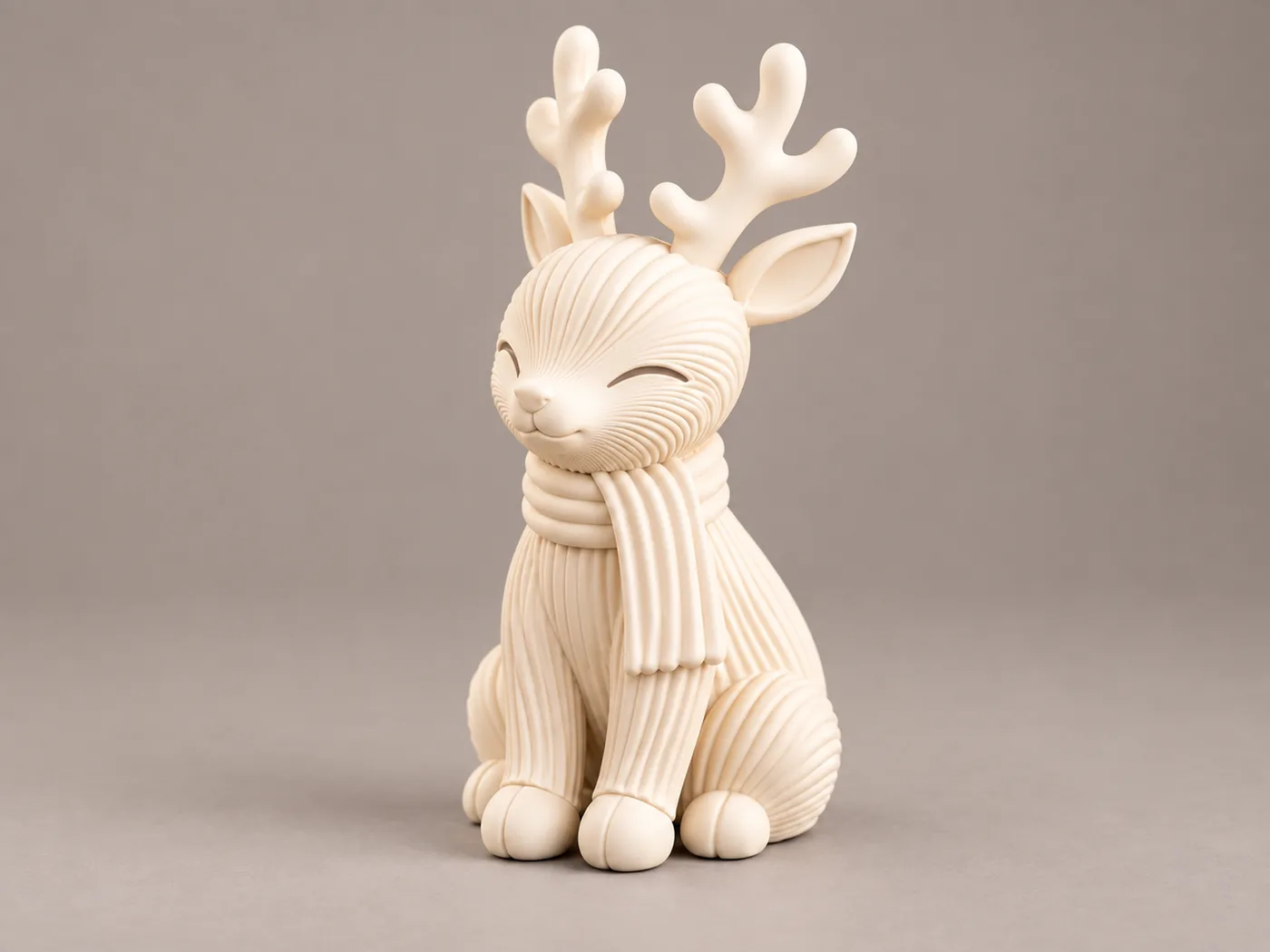 The only input: one 1,517,781 B PNG, sha256 8ba545f2… Both products received this exact file on default settings. The stress axes are visible in it — multi-branched antlers that could fuse into a lump, and fine corduroy ribbing that could get smoothed away. The camera never sees the back of the head, so everything behind the ears is invented by both.
The test, in one paragraph
One photo, two products, one day. Tripo Studio on its shipped default: Best Quality selected, Clean Topology unselected — Tripo marks that switch Trial ×2. SupaVoxel on a full model with Advanced Options at defaults: Inference Steps 5, Guidance Scale 5.5, Octree Resolution 256. Both GLBs were parsed offline; not one number below was copied off a panel. Every render uses one lighting rig and one set of cameras, corrected for export orientation, so each pair is the same viewpoint rather than two flattering angles.
Both products passed both things this case was chosen to break
This reindeer is in the test set for two reasons. The antlers — four tines left, five right, each branching off a main beam — are exactly the geometry that collapses into a mitten when a reconstruction under-resolves. And the corduroy can be faked with a 4096 normal map, which looks identical in a viewer and prints as a smooth blob.
Neither product failed either one. Tripo kept all nine tines separate with real air between them; so did SupaVoxel. With every texture switched off, both sets of ribs are still cut into the geometry — including on the back of the head, which the input photo never shows and both products invented. A shared pass is the real result here and I am reporting it as one.
- Antler tines surviving as separate prongs — Tripo 9/9 · SupaVoxel 9/9
- Ribbing present on the untextured mesh — Tripo yes · SupaVoxel yes
- Ribbing on the unseen back of the head — Tripo yes · SupaVoxel yes
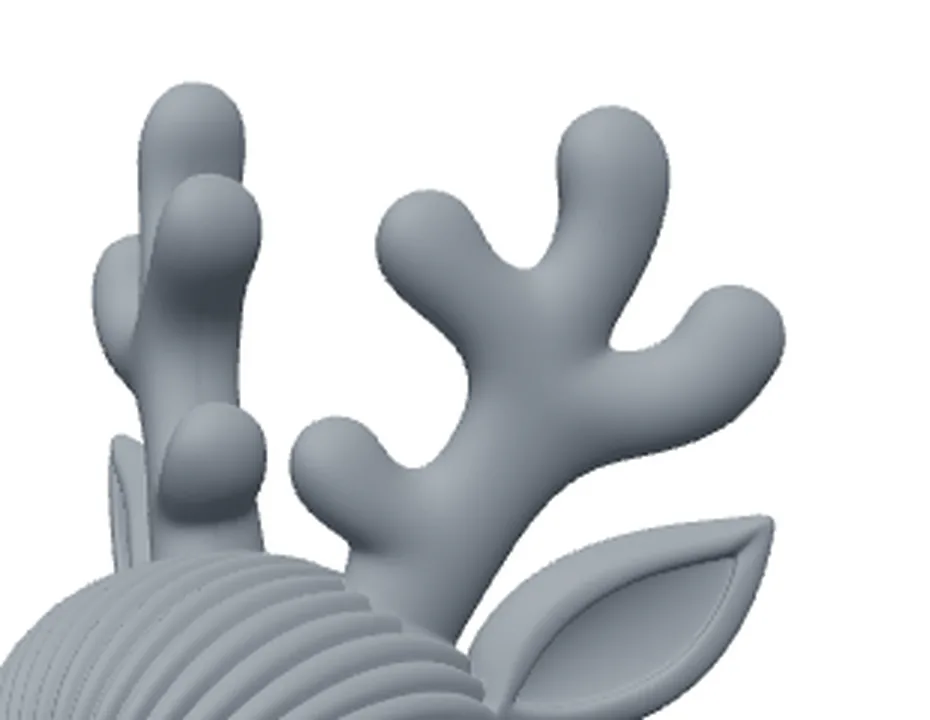 SupaVoxel's antlers, cropped from the untextured mesh render. Every tine is a separate round beam and each tine root carries a visible fillet into the main branch. Note how thick they read — that thickness is the entire article.
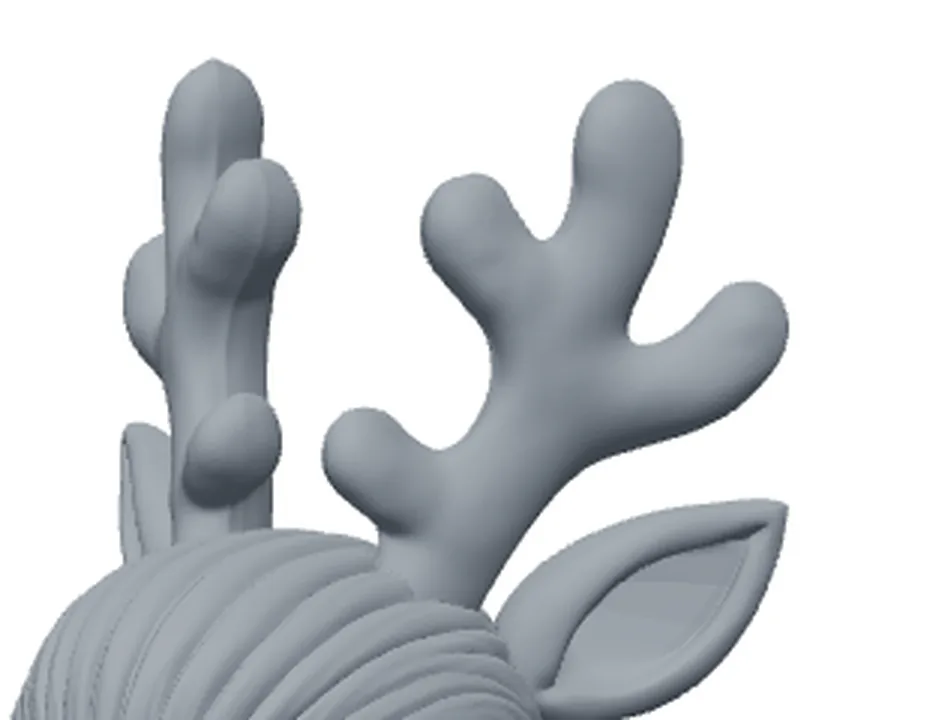 Tripo, same camera, same crop, textures off. Tripo's tines are also fully separate — the pass is real. The difference is the taper: each Tripo tine narrows into a tight neck where it meets the beam, with no fillet. That neck is where the 0.943 mm cross-section lives.
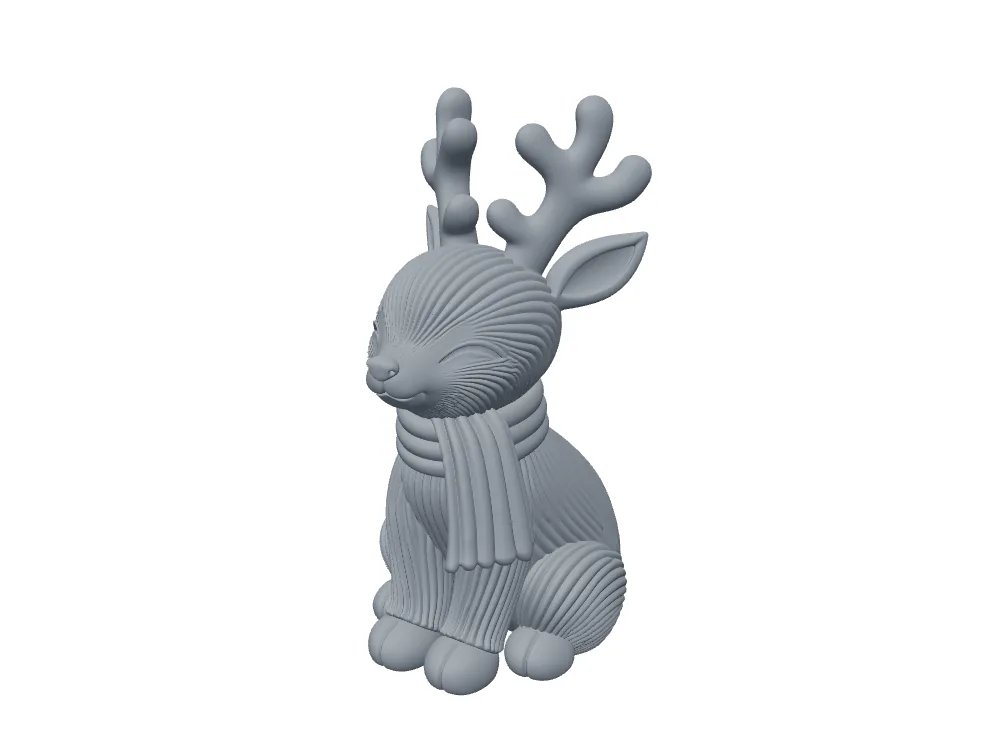 SupaVoxel with all textures off. The corduroy grooves are still there — real depth, not a normal map. The scarf reads as three separate rope coils with clean valleys between them, and the antlers are thick round beams.
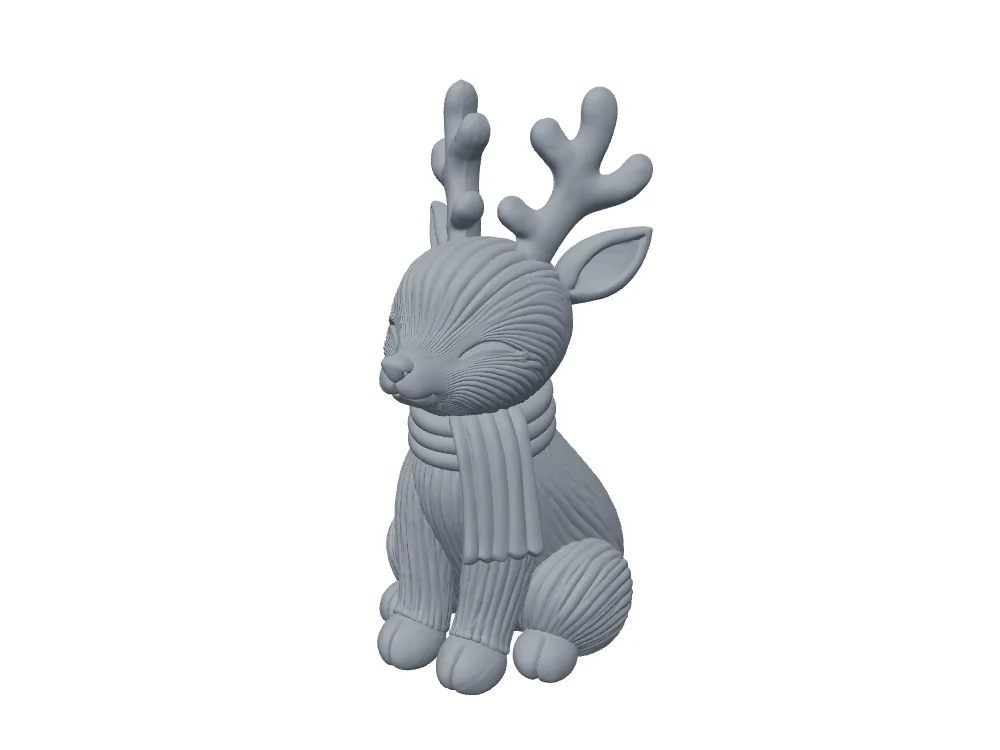 Tripo, same camera, textures off. Tripo's ribs are also genuinely displaced, so the "fake texture" accusation does not apply. What the untextured render does expose is the antler necks and an ear that is a hollow thin spoon rather than a leaf with thickness.
How I measured wall thickness: 1 mm slices at 120 mm tall
Renders do not settle printability arguments. Slices do. I scaled both meshes to a 120 mm tall bounding box, then cut them horizontally every 1 mm through the top 30% — 72 slices for Tripo, 74 for SupaVoxel. For each closed loop I took min(x span, z span) as the narrow-direction width. Above 96 mm, past the ear tips, the only loops left are antlers. Same script, same height convention, both files.
- Slices taken — Tripo 72 · SupaVoxel 74
- Bounding box at target — Tripo 60.61 × 120.0 × 71.66 mm · SupaVoxel 59.14 × 120.0 × 80.85 mm
- Nozzle assumed — 0.4 mm, both
The thinnest antler section: 0.943 mm against 3.116 mm
This is the number. Tripo's narrowest antler cross-section, across all 72 slices, is 0.943 mm; SupaVoxel's is 3.116 mm. In nozzle widths: 2.36 against 7.79. At 2.36 the printer lays down two perimeters and has nothing left over — no infill, no core, and the moment your slicer's thin-wall handling kicks in, that tine goes hollow or disappears. At 7.79 it is a solid beam.
- Thinnest antler cross-section — Tripo 0.943 mm · SupaVoxel 3.116 mm · 3.3×
- In 0.4 mm nozzle widths — Tripo 2.36 · SupaVoxel 7.79
- Perimeters that fit — Tripo 2, no core · SupaVoxel 7+, solid
That is the whole trade. Tripo's antlers look sharper in every render in this article, and they look sharper because Tripo made them thinner than the machine can build.
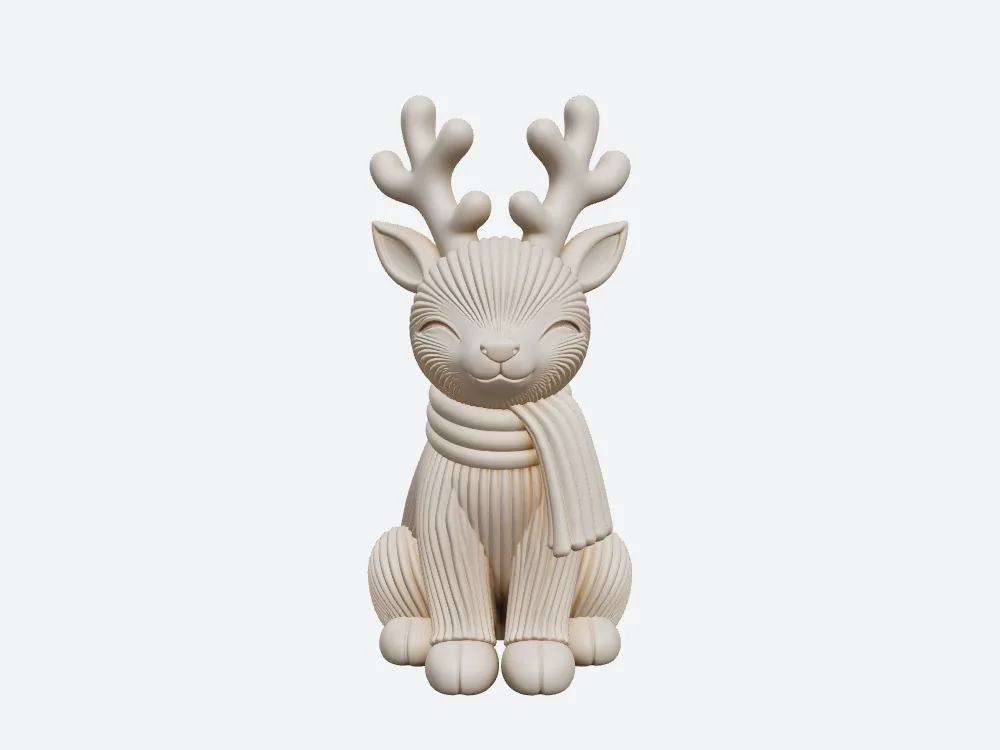 SupaVoxel, front. Antlers are round beams, the ears are thick leaves with a visible rounded outer rim, and the scarf is a bundle of raised cords. It reads fatter than Tripo's, and that is not a fidelity loss — it is 7.79 nozzle widths of antler.
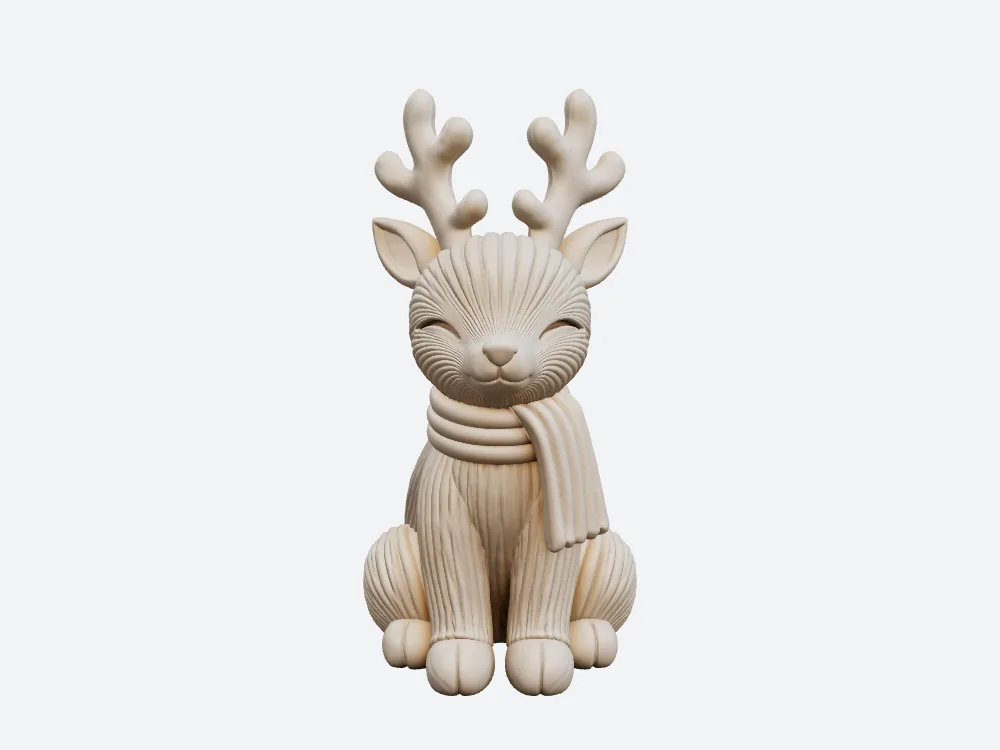 Tripo, same camera. Sharper, leaner, ribs packed denser. Every one of those tines is narrower, every tine root pinches harder, and the ears have thinned into flat shells. On screen Tripo wins this frame. On a print bed it is 0.943 mm.
The ear rims: 0.148 mm is below one extrusion line
Taking the whole top region rather than just the antlers, Tripo's absolute minimum wall is 0.148 mm, at the ear rims. That is 0.37 of one nozzle width — thinner than a single extrusion line, and a slicer does not warn you. It cannot lay down 0.37 of a line, so it discards the feature and keeps going; the ear comes off the bed with its rim missing. SupaVoxel's minimum over the same region is 0.398 mm: one extrusion line, exactly. Not generous, but it exists on the printed part.
- Thinnest wall anywhere in the top region — Tripo 0.148 mm · SupaVoxel 0.398 mm · 2.7×
- In nozzle widths — Tripo 0.37 · SupaVoxel 1.0
- Slicer behaviour — Tripo: silently discarded · SupaVoxel: one perimeter, printed
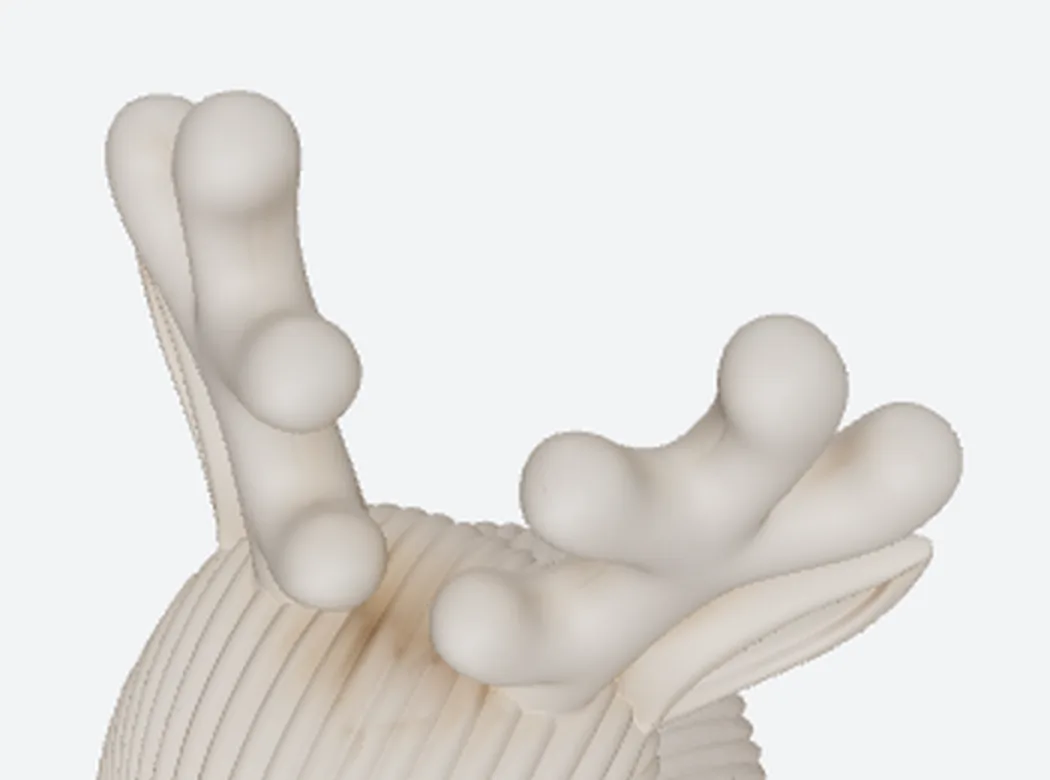 SupaVoxel from directly above, antlers and ears. Every tine points a different way and none touch. Both ears read as leaves with obvious width — you can see the rim roll over.
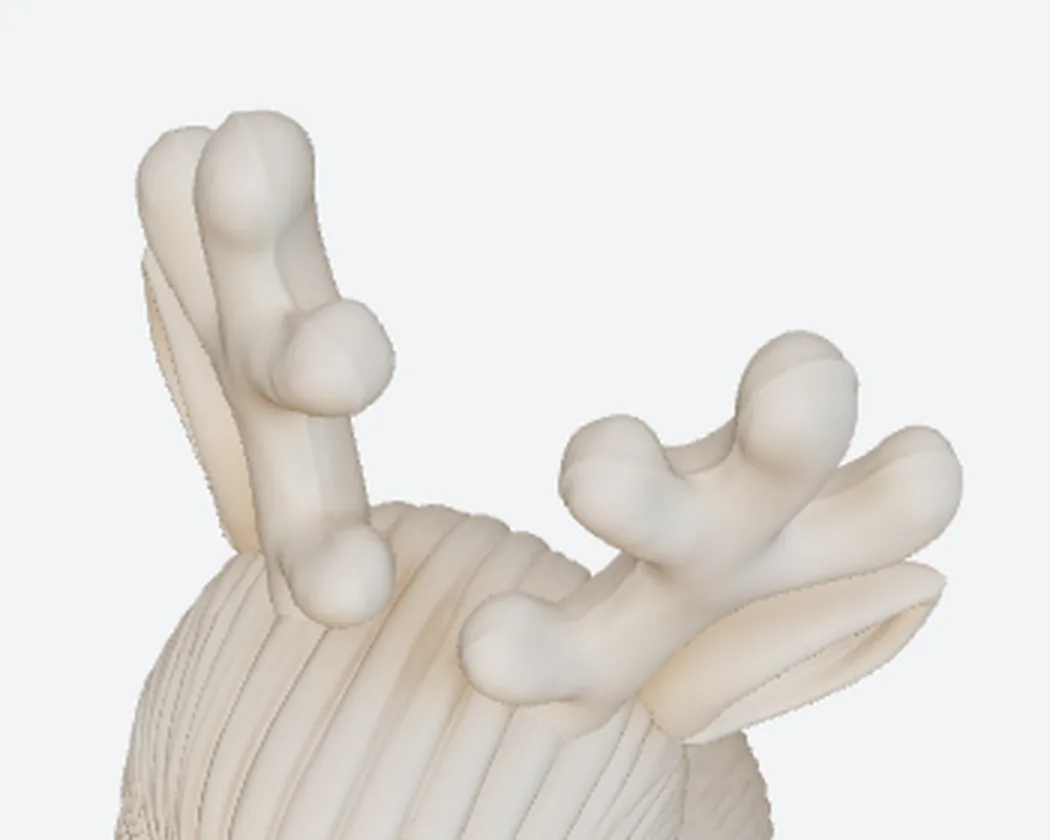 Tripo, same viewpoint. The tines are separate here too. The ears are the story: from above they have narrowed to something close to a line. That is what 0.148 mm looks like before a slicer throws it away.
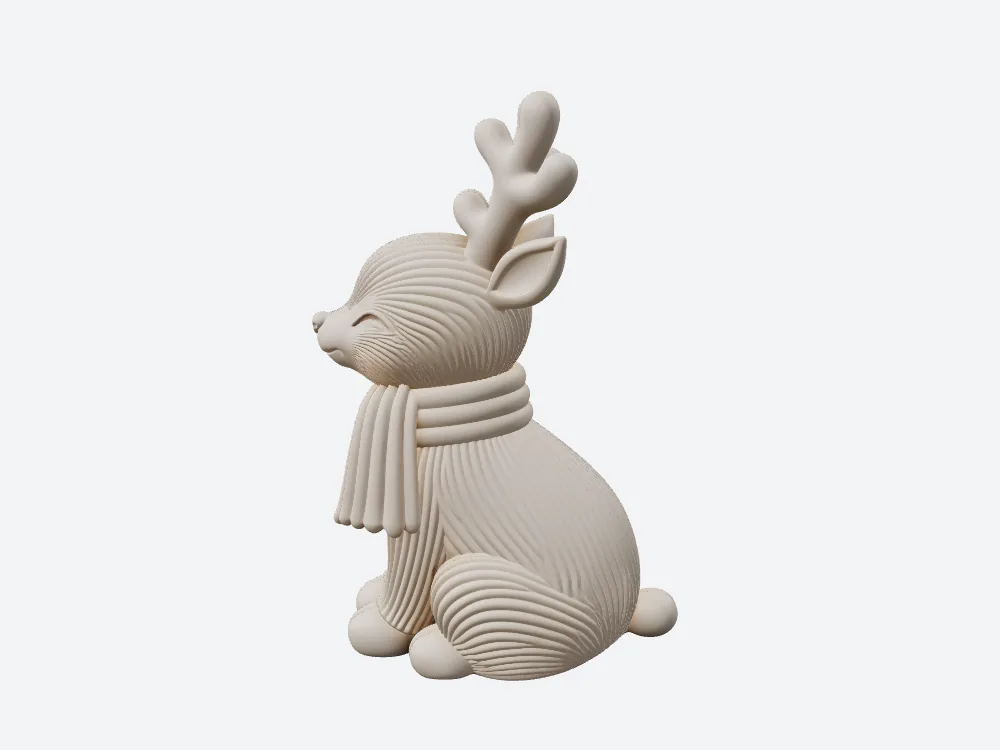 SupaVoxel in profile. The ear is a leaf with thickness and a rounded outer edge, and the antler tine roots have a visible chamfer into the beam. Rump ribbing sweeps across the curve unbroken.
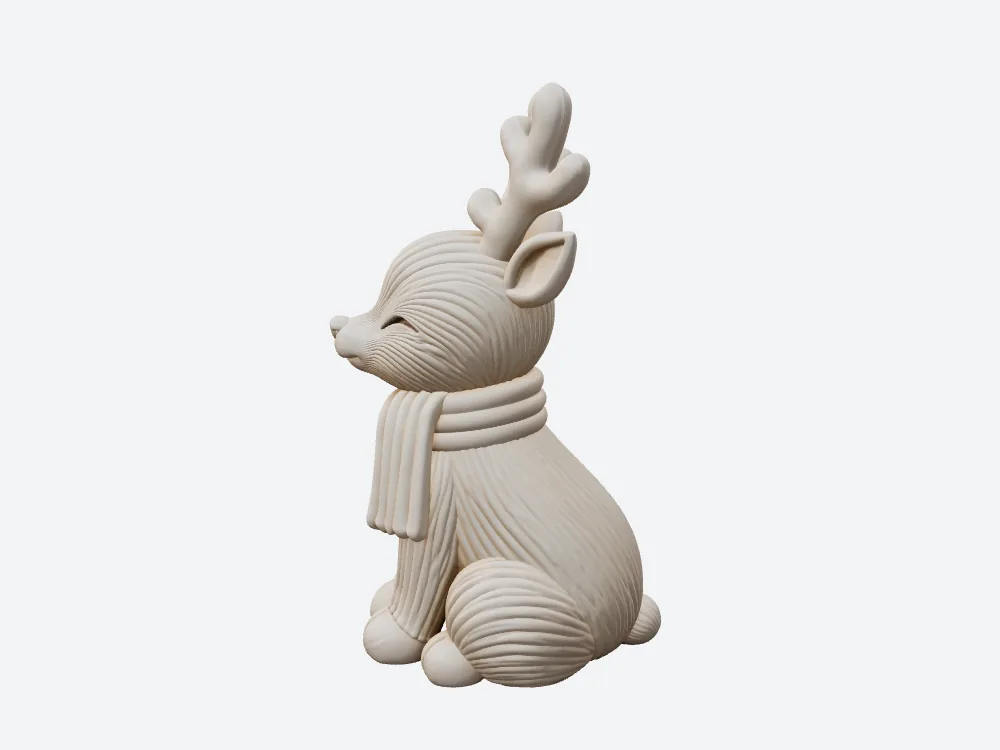 Tripo, same profile. The rump ribbing is finer and shallower, and near the spine it starts smearing into sheets. The ear at this angle has almost no visible thickness at all — it is a shell, which matches the 0.148 mm the slicing pass found.
It is not one unlucky slice — the whole distribution leans the wrong way
A single worst-case number can be an artefact, so here is the rest of the antler-width distribution. Tripo is thinner at every point I checked, not just at the minimum — and the tips, where the gap is widest, are the part of a reindeer people pick it up by.
- Antler width, minimum — Tripo 0.943 mm · SupaVoxel 3.116 mm
- Antler width, 5th percentile — Tripo 2.873 mm · SupaVoxel 4.584 mm
- Antler width, median — Tripo 6.672 mm · SupaVoxel 7.538 mm
Triangle count is not the variable here — both are already finer than the nozzle
Tripo delivers 1,996,779 triangles to SupaVoxel's 1,499,386, a 1.33× lead, easily read as Tripo buying detail. Convert it into the only unit a printer understands and it evaporates: at 120 mm tall Tripo's mean triangle edge is 0.1851 mm and SupaVoxel's is 0.2338 mm, against a 0.4 mm nozzle. Tripo is 2.2× finer than the tool, SupaVoxel is 1.7× finer. Both are already past the point where geometry turns into plastic, so Tripo's extra 497,393 triangles buy bytes, not detail.
- Triangles — Tripo 1,996,779 · SupaVoxel 1,499,386 · 1.33×
- Mean edge at 120 mm — Tripo 0.1851 mm · SupaVoxel 0.2338 mm
- Finer than a 0.4 mm nozzle by — Tripo 2.2× · SupaVoxel 1.7×
The obvious retort is that SupaVoxel simply ships leaner meshes. It does not: across the ten cases I ran, SupaVoxel's counts run from about 945,000 to 2,786,054, a 146% spread scaled to the subject, while Tripo's run 1,896,372 to 1,996,779 across nine — a spread of 5.2% of the mean. Tripo spends a fixed house budget on every object. Ten cases each is a sample, not a law. On the tank case in the same batch SupaVoxel shipped 44% more triangles than Tripo did.
What Tripo's file needs before a slicer will take it
After welding vertices by position — which every slicer does on import — Tripo's mesh is not a solid. Two boundary edges, which are holes. Two non-manifold edges. Inconsistent winding, so some faces point inward. Two connected components, meaning a piece of the reindeer is a separate floating shell. Euler characteristic −7, the arithmetic confirming all of it. The SupaVoxel file, same pass: watertight, 0 boundary edges, 0 non-manifold edges, consistent winding, 1 component, Euler 0 — the textbook value for a closed genus-1 surface.
- Watertight after welding — Tripo false · SupaVoxel true
- Boundary edges (holes) — Tripo 2 · SupaVoxel 0
- Non-manifold edges — Tripo 2 · SupaVoxel 0
- Winding consistent — Tripo false · SupaVoxel true
- Connected components — Tripo 2 · SupaVoxel 1
- Euler characteristic — Tripo −7 · SupaVoxel 0
That is a repair pass — patch two holes, unify the normals, merge two shells — before Tripo's 55-credit file becomes something you can slice. And note which switch would have helped: Tripo's Clean Topology mode is the one that cleans this up, it is off by default, and Tripo labels it Trial ×2. Two uses.
 Tripo Studio with the photo uploaded. The quality selector sits on Best Quality; Clean Topology beside it carries a Trial ×2 badge and is not selected. Everything measured above is what Tripo's default ships.
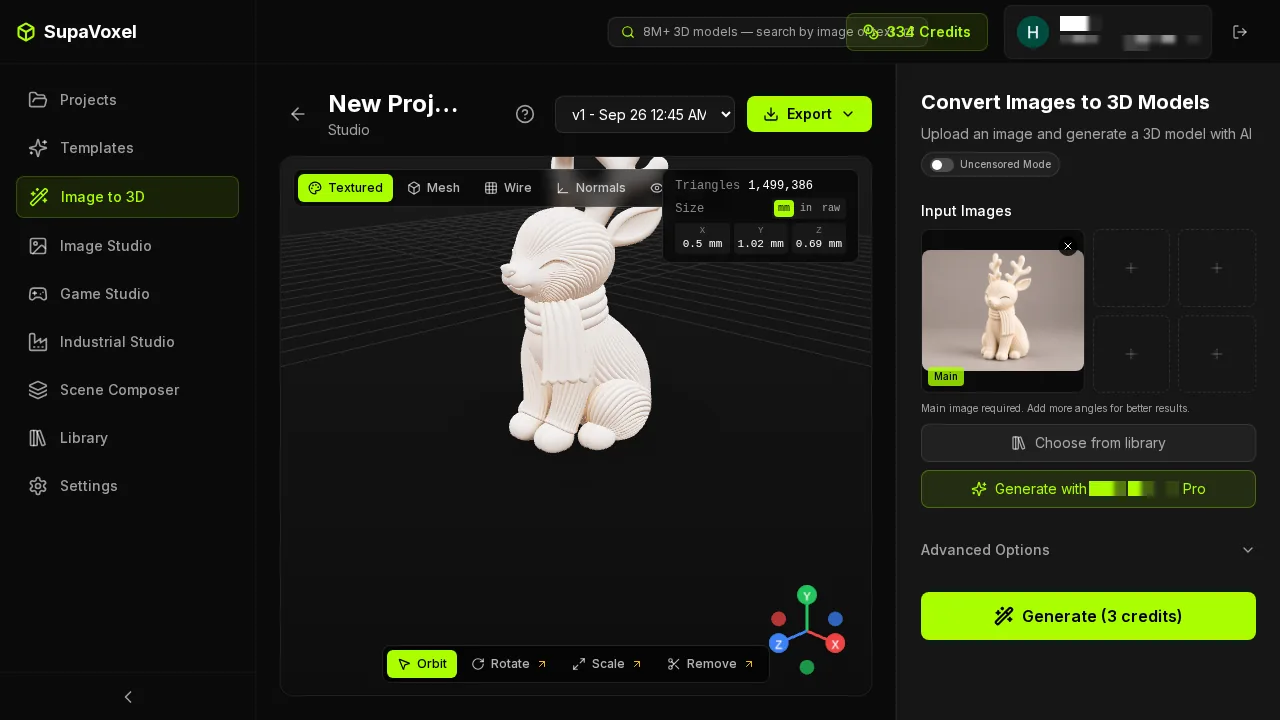 The SupaVoxel result page. Four inspection modes — Textured, Mesh, Wire, Normals — switch with one click, and the triangle count top right reads 1,499,386, which matched the downloaded GLB exactly. Tripo's panel figure matched its GLB too; that row is a tie and I am recording it as one.
Where SupaVoxel loses: 59 degenerate faces and 7,748 slivers
Tripo wins this row and it is not close: 0 degenerate faces and 139 slivers against SupaVoxel's 59 and 7,748 — 56× more thin, badly-shaped triangles in the same silhouette. The exchange rate: SupaVoxel's 7,748 slivers sit inside a watertight, consistently wound, zero-non-manifold single shell, while those 139 clean triangles sit inside a shell with two holes, inverted faces and a detached component. A slicer eats slivers without complaint; it does not eat holes and inverted normals.
- Degenerate faces — Tripo 0 · SupaVoxel 59
- Sliver faces — Tripo 139 · SupaVoxel 7,748 · 56×
- Repair operations before slicing — Tripo 3 (patch, unify, merge) · SupaVoxel 0
Where SupaVoxel loses again: $0.45 more resin per copy
Second row that goes to Tripo. At 120 mm tall Tripo's solid volume is 126.56 cm³, $4.43 of resin at $35/L; SupaVoxel's is 139.48 cm³, $4.88 — 10.2% more material, $0.45 more per copy. That $0.45 is not bloat. It is the material cost of taking the thinnest antler cross-section from 0.943 mm to 3.116 mm and the ear rim from 0.148 mm to 0.398 mm — forty-five cents per figurine for a pair of antlers the printer can actually build.
- Volume at 120 mm — Tripo 126.56 cm³ · SupaVoxel 139.48 cm³ · +10.2%
- Resin at $35/L — Tripo $4.43 · SupaVoxel $4.88 · +$0.45
- What the $0.45 buys — antler 0.943 mm → 3.116 mm, ear rim 0.148 mm → 0.398 mm
Support area is a tie, and getting the file out is not
At a 45° threshold Tripo needs 3,714.7 mm² of supported area and SupaVoxel needs 3,780.3 mm² — 1.8% apart, effectively identical. A seated pose with antlers and a chin overhangs on both sides; nobody wins that row.
Export is a different story. Tripo's is short once you reach it — File Name, Format, Texture Resolution, Export: two steps measured. Reaching it is the problem, because clicking Export opens the dialog with Tripo's Guide popup on top of it, covering two of the three fields. I did not record my click count from the SupaVoxel result page to the downloaded file in this run, so that cell stays empty rather than estimated. Not measured is not zero.
- Support area at 45° — Tripo 3,714.7 mm² · SupaVoxel 3,780.3 mm² · 1.8% apart
- As a fraction of surface — Tripo 16.37% · SupaVoxel 15.00%
- Export steps — Tripo 2 · SupaVoxel not measured this run
- Modal dialogs between result and export — Tripo 2 · SupaVoxel 0
 The Tripo export dialog with Tripo's own Guide popup covering it. File Name and Format are both behind the tutorial. This is the screen you land on after paying 55 credits.
Final verdict: Tripo scores 60, SupaVoxel scores 90
Tripo passed the axis this case was built to stress — nine antler tines, nine separate prongs — and Tripo's ribbing is real displaced geometry, including on the invented back of the head. Tripo's triangulation is cleaner, 139 slivers to 7,748, and Tripo's print costs $0.45 less in resin. All three are real and all three are priced above.
What Tripo charged for them: 0.943 mm antler tines, a 0.148 mm ear rim the slicer deletes without a warning, a mesh in two pieces with two holes and inverted faces, and 55 credits against 3. Tripo's reindeer is sharper on screen, and that sharpness is the part that does not survive a 0.4 mm nozzle. Triangle count did not decide this case — both products are already finer than the printer. Wall thickness decided it.
Tripo: 60/100. SupaVoxel: 90/100.
Which one I would use for this job
If the job is turning a photograph into a figurine that comes off the bed intact, use SupaVoxel. You get a watertight, consistently wound single shell with zero non-manifold edges, antler tines at 7.79 nozzle widths instead of 2.36, an ear rim that is one full extrusion line instead of 0.37 of one, for 3 credits instead of 55. You pay $0.45 more in resin and you accept 7,748 sliver triangles your slicer will not notice. That is the whole bill.
Three concessions against SupaVoxel, because they are in the measurements too: the export carries no real-world units (the result page reads x 0.5 / y 1.02 / z 0.69 mm, so you scale it yourself); the GLB uses mesh compression and quantization that legacy scripts need one conversion step to open; and the project grid is not reliably newest-first when several generations run at once. None of those change what comes off the print bed.
Originally published on Medium: Tripo AI 3D Model Review 2026: 0.94 mm Antlers on a 0.4 mm Nozzle.